 INKBYTE
Ofcom · CMA · Meta 10-K
The free lunch comes with a receipt
Search and social ring up at £0.00 at the till. The receipt underneath tells a different story, and the longest line on it is time.
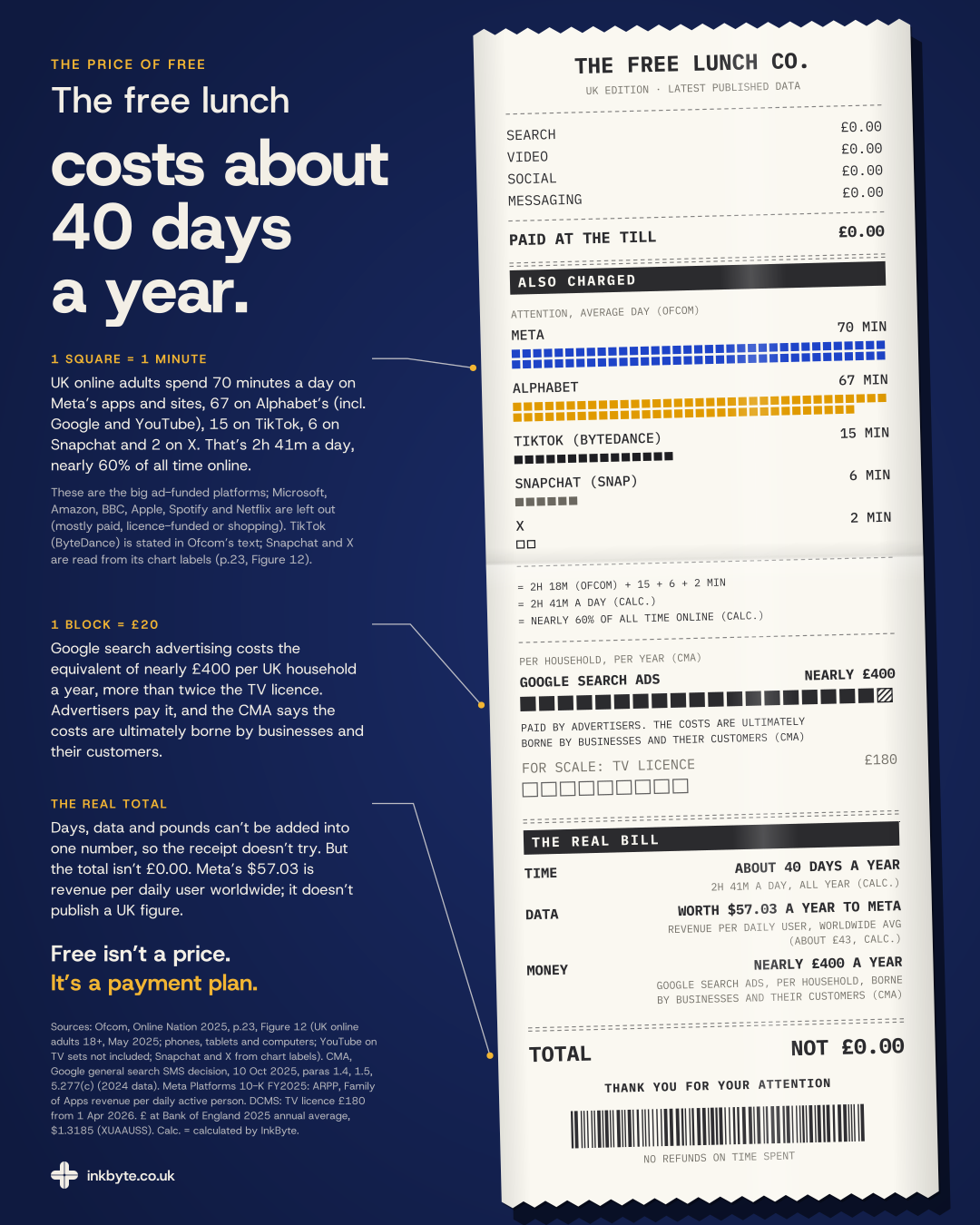
Nobody asks for your card before you look up the bus times or watch someone fix a boiler on YouTube. Search, video, social and messaging all come to £0.00, and the usual line is that we pay with our data instead of our money.
That's half true, and I think it's the less interesting half. When we laid the numbers out as a till receipt for our new InkByte graphic, the Free Lunch Receipt, the line that stood out was time. Money showed up as well, further down, tucked inside the price of other things. Data is on there too, though it's harder to put a number on than you'd expect.
Start with time, because it's the one we notice least. Ofcom's Online Nation 2025 report (p.23, Figure 12) says UK online adults spend 70 minutes a day on Meta's apps and sites and 67 on Alphabet's, which means Google, YouTube and the rest. TikTok, owned by ByteDance, gets 15 minutes. Snapchat gets 6 and X gets 2. I share my work on X too, so I'm on this receipt myself. Two minutes, mind.
Ofcom puts Meta and Alphabet together at 2h 18m a day (its per-company figures are rounded, so they add to 137), which it says is 51% of their time online. Add TikTok, Snapchat and X and it comes to 2h 41m a day by our working, nearly 60% of the 4h 30m a day they spend online in total. Over a year that's 161 minutes times 365 days, divided by the 1,440 minutes in a day, which gives 40.8. So about 40 days a year. Whole days, round the clock, sleep included. As Douglas Adams wrote, "Time is an illusion. Lunchtime doubly so." On this receipt it's the other way round: the lunch is free and the time very much isn't.
A few things to be straight about with those figures. They're averages across all online adults, not what a typical user of each app spends, so the TikTok figure is spread across plenty of people who didn't use it that month. They cover adults 18 and over on phones, tablets and computers, measured in May 2025 (Ofcom published the report on 10 December 2025), and YouTube watched on the telly isn't counted. TikTok's 15 minutes is in Ofcom's text; Snapchat's 6 and X's 2 are read off the labels on Ofcom's chart. We also left Microsoft, Amazon, the BBC, Apple, Spotify and Netflix off on purpose, because they're mostly paid for, licence-funded or shopping, and this receipt is about the stuff that's sold to us as free.
I'm not having a go at anyone over this. I'm in those averages myself, and a fair bit of that time goes on things that matter, like keeping up with family or learning how to do something I'd otherwise pay someone to do. But that time is the payment. It's the attention the advertising gets sold against, and it's the one cost nobody ever itemises.
Then there's money, which is meant to be the thing that's missing. It does move. You just don't see it at the till. On 10 October 2025 the Competition and Markets Authority published its decision on Google's general search services. It says over 200,000 firms in the UK spent more than £10bn on Google search advertising in 2024 (para 1.5). And at para 5.277(c) it says: "The cost of Google's search advertising in the UK is equivalent to nearly £400 per household per year." That's on 2024 data.
For a sense of scale, the TV licence for 2026/27 is £180, from 1 April 2026. Nearly £400 is more than twice that. People argue about the licence fee every single year. I've never once heard anyone argue about the search ad number, probably because it never lands on the doormat.
I need to be careful here, because this one's easy to get wrong. Nobody gets sent a £400 bill, and the CMA doesn't say households hand it over. Advertisers pay Google. What the CMA does say, at para 1.4, is that free search is "paid for through search advertising, the costs of which are ultimately borne by businesses and their customers". It doesn't measure how much of that reaches the price of your shopping, so we don't put a number on it either. It's also Google search only. There's no current regulator figure for social media advertising per household, and I'm not about to make one up.
That's the other half of "you pay with data". The cash still changes hands somewhere along the line. Some of it can end up folded into the prices of the things businesses sell, and the CMA doesn't put a number on how much.
Data is the line everyone expects, and it's the slipperiest. Nobody sells it back to you, so there's no price tag on it. The closest published number is Meta's. In its 10-K (p.66), Meta reports $57.03, Meta's average revenue per person worldwide in 2025 (Family of Apps revenue per daily active person, summed over four quarters; Meta 10-K FY2025). At the Bank of England's 2025 average rate of 1.3185 dollars to the pound (series XUAAUSS) that's about £43, which is our calculation, not Meta's.
It's a worldwide average, though. Meta has never published a revenue-per-user figure for the UK, and its last one for Europe was for Facebook alone, in 2023, so please don't read £43 as what a British user brings in. TikTok and X are private and publish no revenue per user at all. Snap and Pinterest do publish something, but they define it differently, so I haven't stood them next to Meta. Comparing them would look tidy and mean very little.
So what's the total? You can't add days to pounds, let alone dollars, and the receipt doesn't try. What it can say is that the total isn't £0.00.
Free isn't a price, it's a payment plan. The instalment that gets noticed least is time, which is the one currency none of us can earn back, and the rest come out in ways that are much harder to see.
None of this means binning your phone. I won't be. I build things with AI and I post my work on the same platforms that are on this receipt, this piece included. I just think we'd all make slightly better choices, as users and as businesses paying for ads, if "free" came with a receipt a bit more often. About 40 days a year is a lot of lunchtimes.
Rory
At InkByte we go looking for the public numbers that are already out there but buried, and turn them into pictures people actually stop for. This one started life as a chart on page 23 of an Ofcom report, a paragraph deep in a CMA decision and a line in an American company filing. We put them on the same piece of paper, a till receipt, because everyone knows how to read one of those. More at inkbyte.co.uk.