 INKBYTE
ONS · Home Office
Fraud has become something you sort out with the bank
It's nearly half of all crime in England and Wales, there's more of it than there was in 2016-17, and a smaller share of it reaches the police.
Nearly half of all crime in England and Wales is now fraud, and the more of it there is, the smaller the share the police ever hear about.
I spent about twenty years running social media for international brands, so I've a fair idea how a number turns into a story and how a story turns into what people think is true. Whatever gets counted in public gets argued over and, now and then, fixed, while whatever doesn't get counted tends to drift out of the conversation altogether. That's why our new Fraud iceberg graphic at InkByte has stuck with me.
Start with the size of it. The Crime Survey for England and Wales estimated 9.70 million crimes against adults and households in the year ending June 2026, and 4.53 million of them were fraud. By our working that's 46.7%, close enough to half that the old picture of crime as a burglary or a scrap outside a pub needs redrawing. About 1 in 13 adults (7.8%) was a victim of fraud over the same twelve months. The survey only covers adults aged 16 and over living in households, so it's a picture of fraud against people at home rather than every fraud going, and it's a survey estimate.
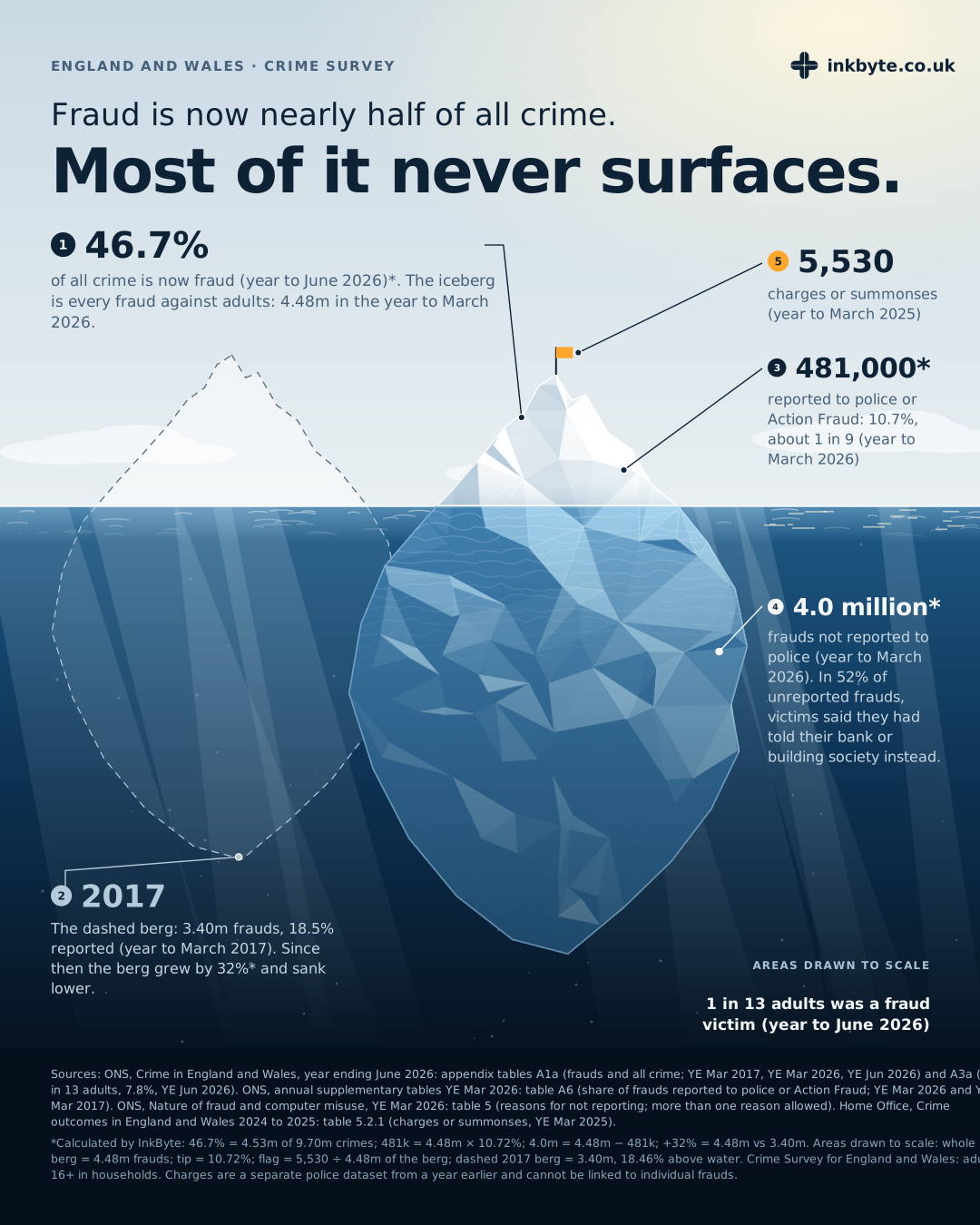
The graphic draws every fraud against adults in 2025-26 as one iceberg, to scale. That's 4.48 million incidents in the year ending March 2026. Only 10.7% of them were reported to the police or Action Fraud (now Report Fraud), roughly 1 in 9, which comes to about 481,000 by our sums, and the other 4.0 million or so stayed under the water. Right on the peak sits a little orange flag for charges, and it's barely a speck. Police recorded 5,530 fraud outcomes that were a charge or summons in the year ending March 2025, up 49% from 3,699 in the year ending March 2024, which is progress of a sort. I should be careful with that one, mind. It counts outcomes, meaning offences closed, rather than people charged, it includes 473 outcomes where the charge was for a different offence, and it comes from a separate police dataset a year earlier than the survey, so you can't line it up against individual frauds. It's still the latest figure there is, because the 2025-26 outcomes release didn't include fraud; the Home Office says that chapter will follow later.
What I keep coming back to is the comparison with 2016-17, the earliest financial year in the survey's fraud series. The survey started asking about fraud in October 2015, so 2016-17 isn't the first time anyone measured it, it's just as far back as this series goes. Back then the survey counted 3.40 million frauds and 18.5% of them were reported. By 2025-26 there were 4.48 million, up 32%, and the reported share had dropped to 10.7%. So the berg has grown and it's sitting lower in the water at the same time, which is the worst combination going if you want the public picture to keep pace with the real one. Anyone who sat through Titanic knows which part of an iceberg you should be worried about.
So where does the rest go? A lot of it goes to the bank, by the look of it. In 52% of the unreported fraud incidents in 2025-26, one of the reasons victims gave for not reporting to the police or Report Fraud was that they'd reported it to a financial authority, such as their bank or building society. That's counting incidents rather than people, it's based on 2,258 incidents in the survey, and people could give more than one reason, so it isn't the same as saying most victims did this. It does tell you where a lot of those calls go, and to be fair to the people making it, it makes perfect sense. If someone's just emptied your account, the bank is the one that can freeze the card and maybe get the money back, and the police don't feel like the obvious number to ring.
I'll stick my neck out here, and this is my reading, not the ONS's. Fraud has turned into a private arrangement between a customer and their bank, when it ought to be a public matter for the police. The ONS table has its own "private matter / dealt with matter themselves" answer, given for 7.2% of unreported incidents in 2025-26, and that's a separate thing entirely. What I mean is that the case gets settled in a call centre or an app and never makes it into the public record.
That matters because public numbers drive public decisions. Recorded crime, charges, court cases, the headlines and the arguments on the telly all start from what gets reported. If a growing share of the most common crime in England and Wales is sorted out in a bank's fraud team, it drops out of all of that. The banks can see it, and they've every reason to want it stopped, but what one bank knows about the scams hitting its own customers isn't the same as a police force or a minister seeing the whole pattern, and it's certainly not a court. Meanwhile the headline total looks like good news: the survey counted 9.62 million crimes in 2025-26, fraud included, down 14% from 11.2 million in 2016-17. Take fraud and computer misuse out and the fall is 28%, while fraud itself rose 32%. It'd be easy to read that as things getting better. None of that means crime has gone away. It's changed shape, moved off the street and into people's phones and bank accounts, where it's a lot harder to see.
So I'd like us to talk about crime a bit differently. When someone says crime is falling, the obvious follow-up is which crime, and who's counting it. When fraud does get covered, it's usually the story of one victim and one nasty scam, and you rarely hear the plain fact that it's nearly half of everything the survey counts. And when we judge how the police are doing on fraud, 5,530 charges and summonses in 2024-25 against millions of incidents ought to be enough to start an argument, even allowing for the fact that those two numbers come from different datasets and different years.
If it happens to you, tell your bank first, because they're the ones who can stop the money moving. Then report it to Report Fraud as well, at reportfraud.police.uk or on 0300 123 2040. It replaced Action Fraud on 4 December 2025 and had its full public launch in January 2026, and reporting there means your fraud ends up in the public count and not only in the bank's files. The full graphic is above if you want to share it with someone who still thinks crime means burglary.
Rory
Rory Wilmer is the founder and director of InkByte. The Fraud iceberg graphic is by InkByte (inkbyte.co.uk).